
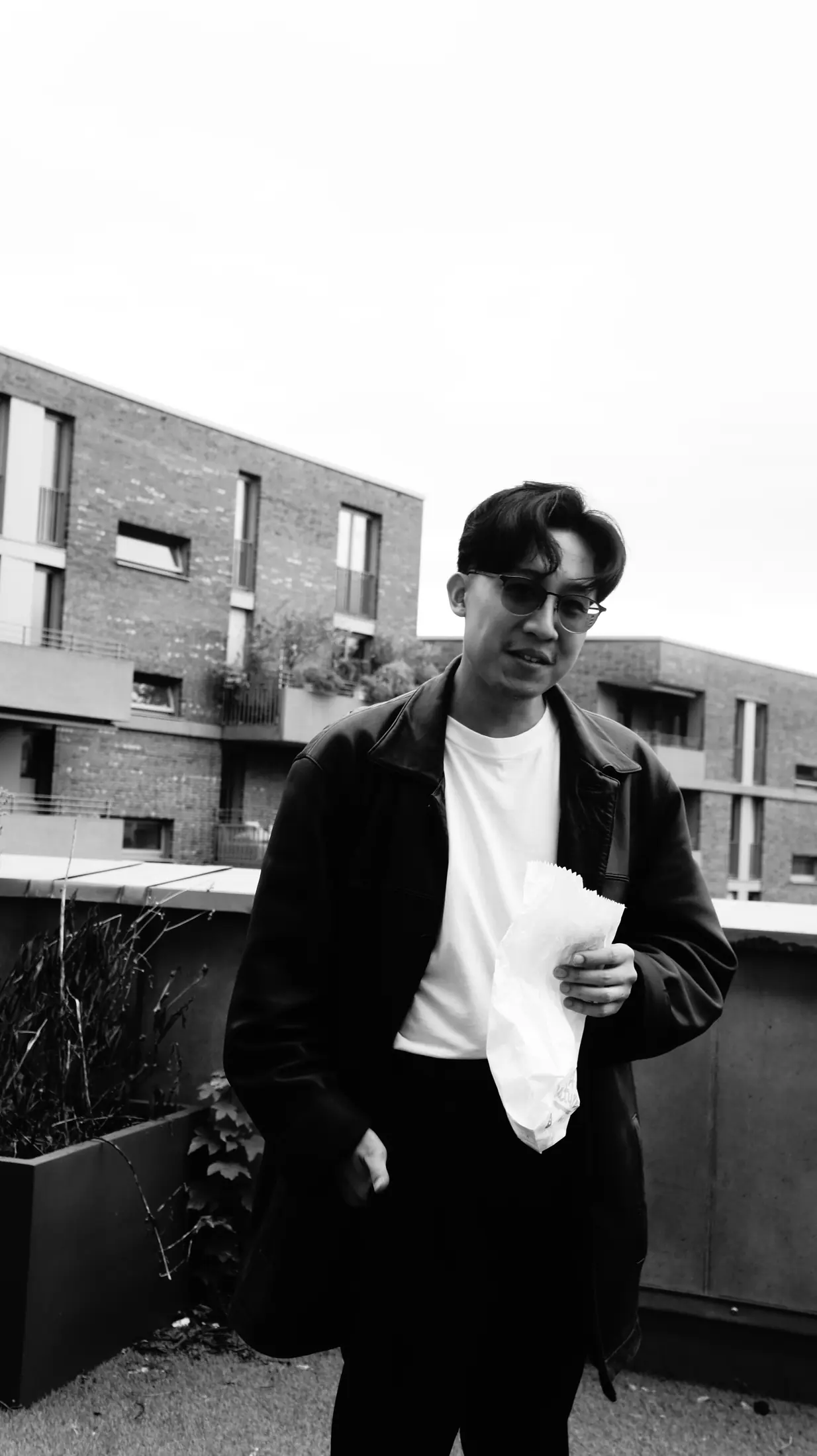
JazzingFfm accompanied Fathan Nauv to an improvisation session with two contemporary dancers. The interplay of music, movement and spontaneous reactions was magical.
In Frankfurt, Fathan hosts jam sessions, plays guitar in his quintet Nauvality and bass in the JLF Project. Yet his versatility never feels arbitrary. We spoke with him about his musical influences, the Frankfurt scene and how to remain flexible without losing your own identity.
JazzingFfm: Fathan, you grew up near Nuremberg and moved to Frankfurt after finishing school. Where does your personal story begin, and where does your story as a musician begin?
Fathan: I grew up near Nuremberg and moved to Frankfurt after finishing school. At first, I studied computer science. But music had always been there. There was no single moment when I suddenly decided that I wanted to become a musician. I knew from an early age that music was a central part of my life.
Nobody in my family is a professional musician. Still, my decision was not a spontaneous one. I had already been playing for a long time and had invested a great deal of time and energy in my instruments. At some point, it became clear that I wanted to pursue this path seriously.
JazzingFfm: Which instrument came first, the guitar or the bass? And how did you learn to play?
Fathan: My first instrument was classical guitar. I started at around the age of seven and took lessons at a music school. The motivation came from within me. I was never forced to play music, and to this day I do not really know why I wanted to play the guitar so badly.
Alongside my lessons, I started experimenting on my own at an early age. I did not just want to play what I was shown. I also wanted to learn songs by ear and play along with music. Little by little, I discovered which notes worked. As a child, I did not know how to do that “properly.” Nobody had explained it to me, so I had to figure it out for myself.
Of course, you also pick up a few bad habits that way. That is why studying music later was valuable. But this DIY approach was very important to me. It allowed me to discover what worked for me without filtering myself, before anyone told me what was supposedly right or wrong.
JazzingFfm: Which kinds of music influenced you most when you were younger?
Fathan: The internet gave me a great way to discover music. I did not have much money as a student, but online I could listen to all kinds of music and find out what I liked and what I did not.
Electronic music was one of my first great musical loves. It made me think about how a piece works as a whole, rather than just how it sounds instrumentally. How is it structured? How do its individual elements develop? How do different sounds come together to create a coherent form? I found that incredibly exciting.
JazzingFfm: You also spoke about gamelan, the traditional Indonesian musical ensemble. What does this music mean to you?
Fathan: Much of what other people might perceive as exotic never really felt exotic to me. Those sounds felt normal and familiar, sometimes even like home.
Gamelan music fascinated me. I tried to recreate certain sounds and musical ideas and translate them onto my own instruments. Through this fascination, I later discovered older Indonesian jazz and fusion music, particularly recordings from the 1980s. I really enjoyed that music, and it continued to shape my musical approach.
JazzingFfm: From there, you also found your way to Japanese fusion. How did that lead you to the bass?
Fathan: I first discovered Indonesian jazz and fusion music. Later, I came across Japanese fusion bands such as Casiopea and T-Square. I was particularly impressed by Tetsuo Sakurai, Casiopea’s longtime bassist. He made me want to play bass myself.
At some point, I sold something and bought my first bass when I was around 15 or 16. The transition was not particularly difficult for me. I had already played those lines on the guitar, so switching to the bass felt quite natural.
JazzingFfm: How did jazz enter your life after that?
Fathan: Once I had the bass, I naturally wanted to play with other people. That is why I joined my school’s big band. Until then, the traditional jazz scene had not really entered my world. At first, I was simply doing a lot of it for fun. Classical guitar was what I had formally studied. Jazz became a much stronger influence through the big band.
My classical training taught me a great deal about technique and how to produce a good sound on an instrument. I also learned not to focus solely on individual notes, but to consider the whole picture. How do you present yourself? What kind of presence do you have on stage? How do you play expressively? My teacher showed me many highly expressive approaches, which I then explored for myself. That continues to influence me today.
JazzingFfm: How do you experience the city’s young jazz and improvisation scene?
Fathan: Frankfurt has become my musical base. I am well connected here, I have people around me whom I like, and I am involved in projects that work well.
However, finding the right people takes time. Through your studies and the wider scene, you meet many musicians, play in different projects and try out various constellations.
I cannot yet say whether my future will remain in Frankfurt or eventually take me to another city. I would also like to get to know other cities and music scenes. At the same time, musicians need a place that serves as their base. For me, that place is currently Frankfurt.
JazzingFfm: You move between different instruments and genres. Is this versatility a strength, or can it also be a challenge for your musical identity?
Fathan: For me, it is definitely a strength. When someone tells me that they recognise this versatility in my playing, I am very grateful.
I do not think you need a particular strategy to develop your own identity. You simply cannot be afraid that other people might judge your work or dislike it. You should be liked and respected for who you truly are, not for something you are not.
JazzingFfm: What insecurities accompany you as a musician? And how do you personally define success?
Fathan: I have fewer insecurities when it comes to my instrument or my music. I think I can assess what works well and what does not in a fairly balanced way.
My insecurities tend to arise through comparison. It is perfectly normal to look around your own scene or bubble and realise that the others are there too. They are just as good and just as technically accomplished. These people are your friends, but in a certain sense, they are also your competitors.
For me, however, success primarily means contentment. It is not only about money, possessions, the number of gigs you play or the projects you are involved in. Self-awareness also helps when making music. When you are able to observe yourself clearly, you understand more precisely what you want to express, what you already do well and what you still need to work on. The way you communicate with others and move within a social environment also begins with yourself.
JazzingFfm: If someone hears Fathan Nauv five years from now, how do you hope your sound will have developed?
Fathan: I want to make a name for myself by being who I am. I want people to hear that I am a flexible and versatile musician. Above all, I want them to know that I make good music.
Essentially, I want to continue doing what I am already doing, but with even more substance, greater commitment and a clearer voice of my own.